(S)125 Cafeteria Plans: The Staffing Industry's Best-Kept Tax Secret
How a simple IRS-approved benefit plan can save your staffing firm thousands in payroll taxes each year — while helping you attract and retain better workers.

If you own or operate a staffing company, you already know that payroll is your single largest line item. What you may not know is that a Section 125 Cafeteria Plan — a simple, IRS-approved employee benefit structure — could be quietly saving your competitors thousands of dollars a year in payroll taxes while you're leaving money on the table.
This post breaks down exactly what a Section 125 Cafeteria Plan is, why it's uniquely powerful for staffing companies, and what you need to do to implement one correctly.
What Is a Section 125 Cafeteria Plan?
A Section 125 Cafeteria Plan — named after the section of the Internal Revenue Code that governs it — is a written, employer-sponsored benefits program that allows employees to pay for certain qualified benefits with pre-tax dollars rather than taxable wages.
The name "cafeteria plan" comes from the idea that employees can choose from a "menu" of benefits that best fit their needs. Those benefit dollars come out of their paycheck before taxes are calculated. Common benefits offered include:
Health insurance premiums — the employee-paid portion of group health coverage
Flexible Spending Accounts (FSAs) — for qualified medical or dependent care expenses
Dental and vision premiums — employee contributions paid pre-tax
Accident and disability insurance — supplemental coverage options
Group-term life insurance — coverage up to $50,000 can be included
Health Savings Accounts (HSAs) — when paired with a qualifying high-deductible health plan

Why Section 125 Plans Are a Game-Changer for Staffing Companies
Most industries benefit from Section 125 plans, but staffing companies stand to gain more than almost anyone else. Here's why:
1. High W-2 Headcount = Amplified Savings
Staffing firms often carry payroll for dozens, hundreds, or even thousands of W-2 employees simultaneously. Because FICA taxes apply to every dollar of taxable wages, the more employees enrolled in a Section 125 plan, the greater your aggregate payroll tax reduction.
Example: A staffing firm with 50 employees each contributing an average of $200/month to pre-tax health premiums reduces its taxable wage base by $120,000/year. At the 7.65% employer FICA rate, that's $9,180 in annual employer FICA savings — before accounting for employee savings.
2. Competitive Advantage in Talent Acquisition
The staffing industry is built on people. Your ability to attract and retain quality workers — temp, contract, and direct-hire — directly impacts your revenue. Offering pre-tax benefit options through a Section 125 plan is a meaningful differentiator that communicates to workers that you're invested in their financial wellbeing.
Many workers choosing between staffing agencies factor in benefit access. A well-structured cafeteria plan can tip the scales in your favor — without increasing your gross pay expense.
3. Workers Effectively Get a Raise — At No Cost to You
A W-2 employee contributing $300/month to pre-tax health premiums saves on both FICA taxes and federal income taxes. Depending on their tax bracket, that employee could take home an additional $900 to $1,200 per year — without you increasing their wage rate by a single dollar.
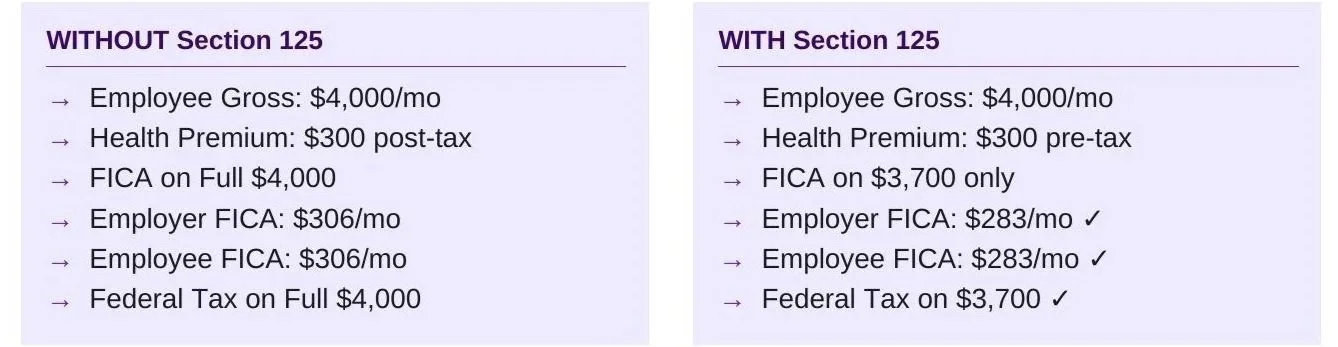
How the Numbers Work: A Side-by-Side Example
Let's walk through a concrete example using a W-2 employee earning $4,000/month with a $300/month health insurance premium:

Compliance Requirements: What You Need to Know
Section 125 plans carry real tax advantages, but they must be structured and administered correctly to maintain their tax-exempt status:
Written Plan Document — A formal plan document must be established before the plan year begins. A missing or deficient document is the #1 reason Section 125 plans lose their tax status
Non-Discrimination Testing — The plan must not disproportionately benefit highly compensated employees (HCEs). Annual testing is required
Qualified Benefits Only — Only IRS-approved benefits may be offered. Cash compensation cannot be included in most standard cafeteria plans
Annual Open Enrollment — Employee elections must be made before the start of the plan year and are generally irrevocable (with exceptions for qualifying life events)
Summary Plan Description — Employees must receive a written SPD detailing plan terms, benefits, and their rights
W-2 Employees Only — 1099 independent contractors cannot participate in a Section 125 plan
⚠️ Important for Staffing Firms: Because staffing companies frequently have a mixed workforce of W-2 employees and 1099 contractors, careful plan design is critical. A plan that inadvertently extends benefits to ineligible workers — or fails nondiscrimination testing — can result in the loss of pre-tax status for all participants, triggering back taxes and penalties. This is why working with an experienced accounting firm is essential.
Common Mistakes Staffing Firms Make with Section 125 Plans
In our work with staffing companies across Florida and beyond, we've seen these recurring mistakes cost firms their tax savings:
🚫No formal plan document — Operating informally without a written plan document means the IRS can disallow the tax treatment retroactively
🚫Skipping annual nondiscrimination testing — If your workforce composition or compensation changes, you could fail testing without knowing it
🚫Including 1099 workers — Allowing contract workers to participate is a compliance violation that can invalidate the entire plan
🚫Missing open enrollment windows — Failing to run a proper annual open enrollment with documented elections jeopardizes pre-tax status for all elections
🚫Misclassifying benefit types — Not all benefits qualify under Section 125. Certain products have specific rules that must be carefully navigated
How C2E Accounting & Tax Helps Staffing Firms Implement Section 125 Plans
Here's how our team walks staffing firms through the process:
✅Workforce Classification Review — We review your employee roster to properly distinguish W-2 employees from 1099 contractors
✅Payroll Tax Savings Modeling — We calculate your projected annual FICA savings based on your actual headcount, compensation, and anticipated benefit elections
✅Plan Design & Documentation — We help you structure a compliant plan document that satisfies IRS requirements
✅Benefits Provider Coordination — We work alongside your existing benefits broker or PEO to integrate the Section 125 plan properly
✅Annual Compliance Support — We conduct nondiscrimination testing, maintain plan documents, and support your annual open enrollment
✅Employee Communication — We help prepare Summary Plan Descriptions and enrollment materials to maximize participation
Frequently Asked Questions
Can part-time staffing employees participate?
Generally yes — part-time W-2 employees can participate, though the plan document can set minimum hour thresholds. Consult your plan document and a tax professional to confirm eligibility criteria.
What happens if an employee wants to change their election mid-year?
Section 125 elections are typically irrevocable for the plan year. However, the IRS allows changes in specific circumstances — such as a qualifying life event (marriage, divorce, birth of a child, or loss of other coverage).
Does a Section 125 plan affect workers' compensation or unemployment calculations?
In most states, pre-tax benefit contributions reduce the wage base used for workers' compensation premiums and state unemployment insurance (SUI) taxes — providing additional savings beyond the FICA reduction. State rules vary.
How long does it take to set up?
A properly structured Section 125 plan can typically be established within a few weeks, assuming your benefit offerings are already in place. The key is ensuring the written plan document is finalized before the plan year begins.
Is this only for large staffing firms?
Not at all. Even staffing firms with 10–20 W-2 employees can realize meaningful savings. The savings scale with headcount, but the compliance structure is the same regardless of firm size.