Why Staffing Companies That Meet Regularly With a Controller or CFO Outperform Those That Don't
Most staffing companies only see their accountant at tax time. The ones growing faster, billing smarter, and keeping more of what they earn do something different — they meet with a financial strategist regularly. Here's what those conversations unlock.
Here's a pattern that shows up again and again in the staffing industry: two firms, similar size, similar markets, similar gross revenue. One is scaling profitably. The other is working harder every year and wondering why the margin never improves.
The difference is rarely the number of clients they have, the verticals they serve, or even the quality of the talent they place. The difference — more often than not — is what happens between the billing and the bank account. It's the financial decisions made at the operational level, often quietly, often without a strategic lens, that determine whether a staffing firm thrives or just survives.
The staffing companies that outperform their peers aren't doing so because they have more sophisticated owners. They're doing it because they have a financial partner — a controller or fractional CFO — who meets with them regularly, keeps a constant eye on the numbers that actually drive profitability, and raises the right questions before small problems become expensive ones.
This piece is about what those conversations look like, what they unlock for staffing companies specifically, and why the firms that invest in this kind of advisory relationship consistently come out ahead.
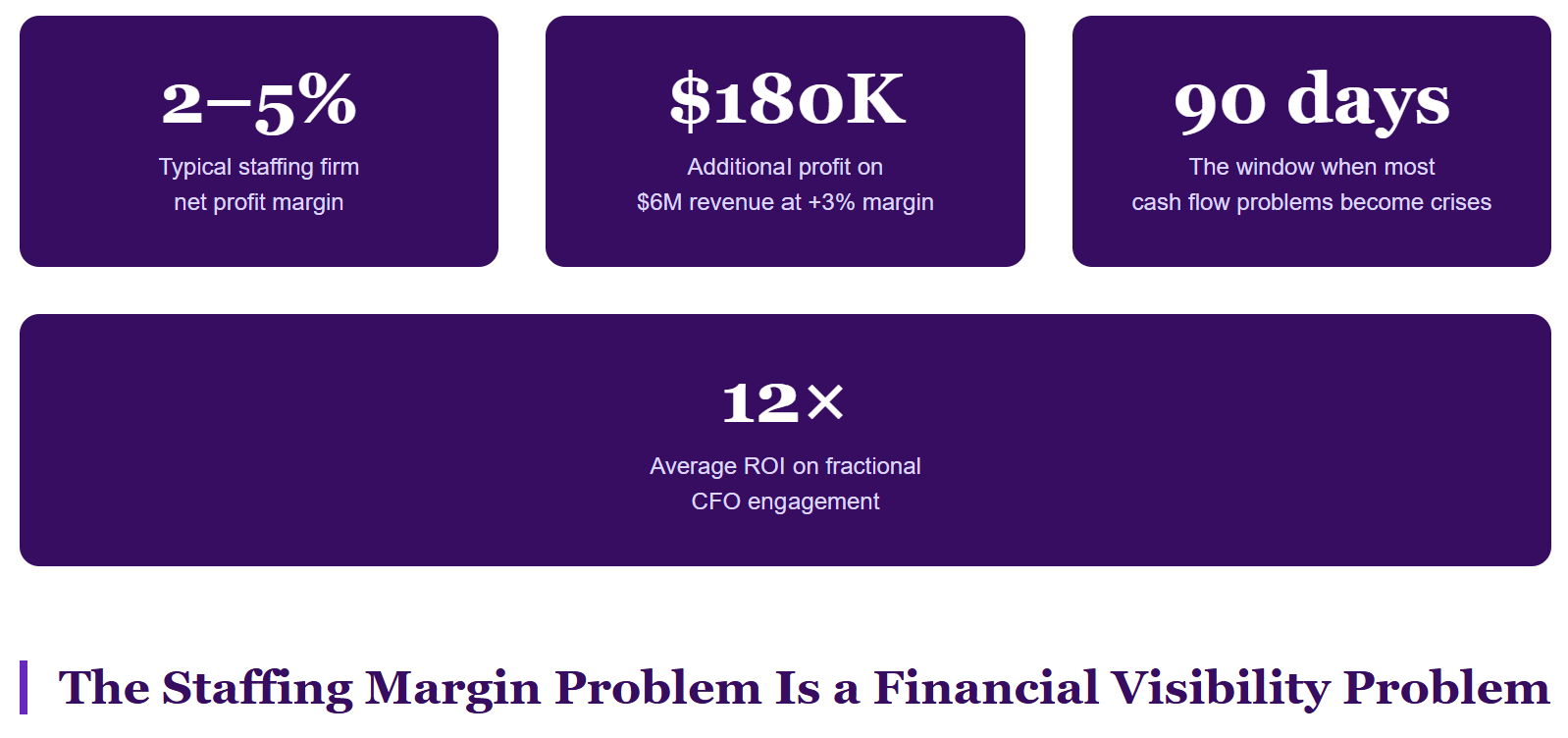
Staffing is a notoriously thin-margin business. Gross margins of 20–35% on bill rates look healthy until you factor in payroll burden, back-office overhead, workers' compensation premiums, unemployment insurance, benefits, and the cost of carrying receivables. Net margins for most staffing firms fall somewhere between 2% and 5%. That's a narrow band — and it doesn't leave much room for financial drift before profitability disappears entirely.
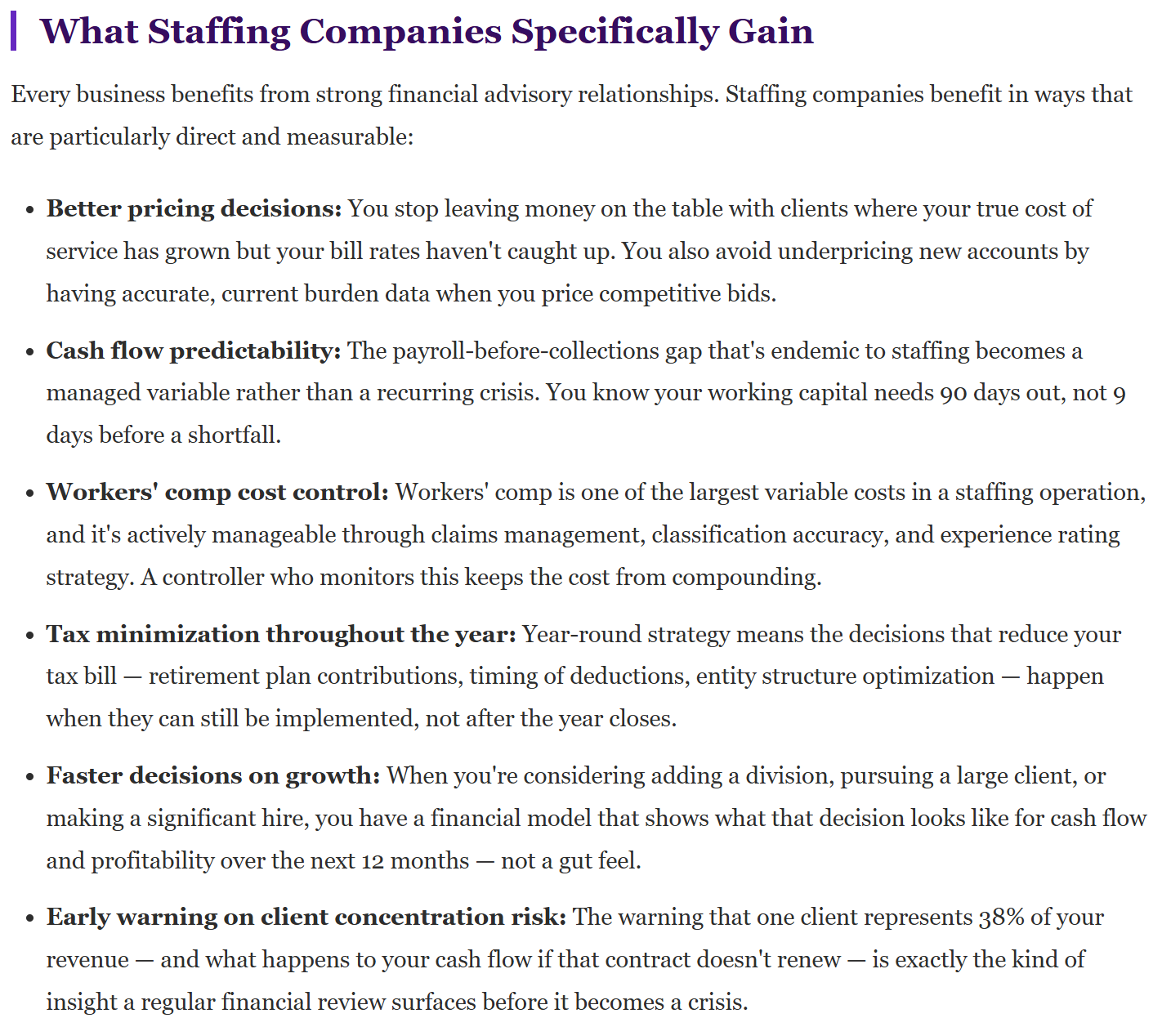
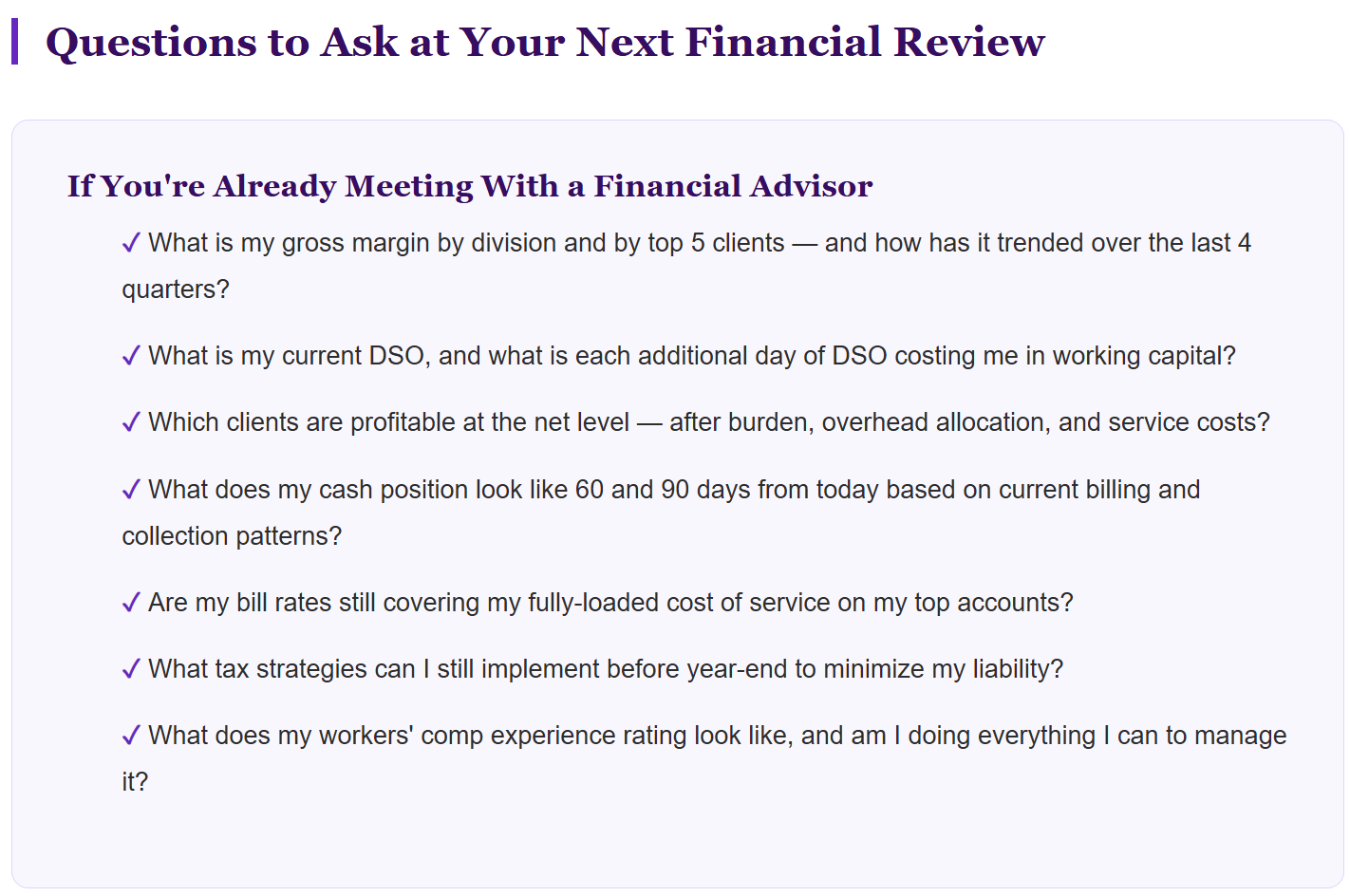
The firms that operate at the higher end of that range — and occasionally above it — aren't just billing more. They're managing their numbers with precision. They know their gross margin by division, by client, and by job type. They know their average days sales outstanding (DSO) and what a one-day improvement in collections is worth in cash. They know which clients are profitable at the net level and which ones are consuming resources that exceed their margin contribution.
Most staffing company owners know their gross revenue. Fewer know their true net profit by division. Almost none can tell you, off the top of their head, what their working capital gap looks like sixty days from now given their current billing and collection cycle.
That's not a failure of intelligence or effort — it's a failure of financial infrastructure. And it's exactly the gap that regular controller or CFO-level engagement closes.
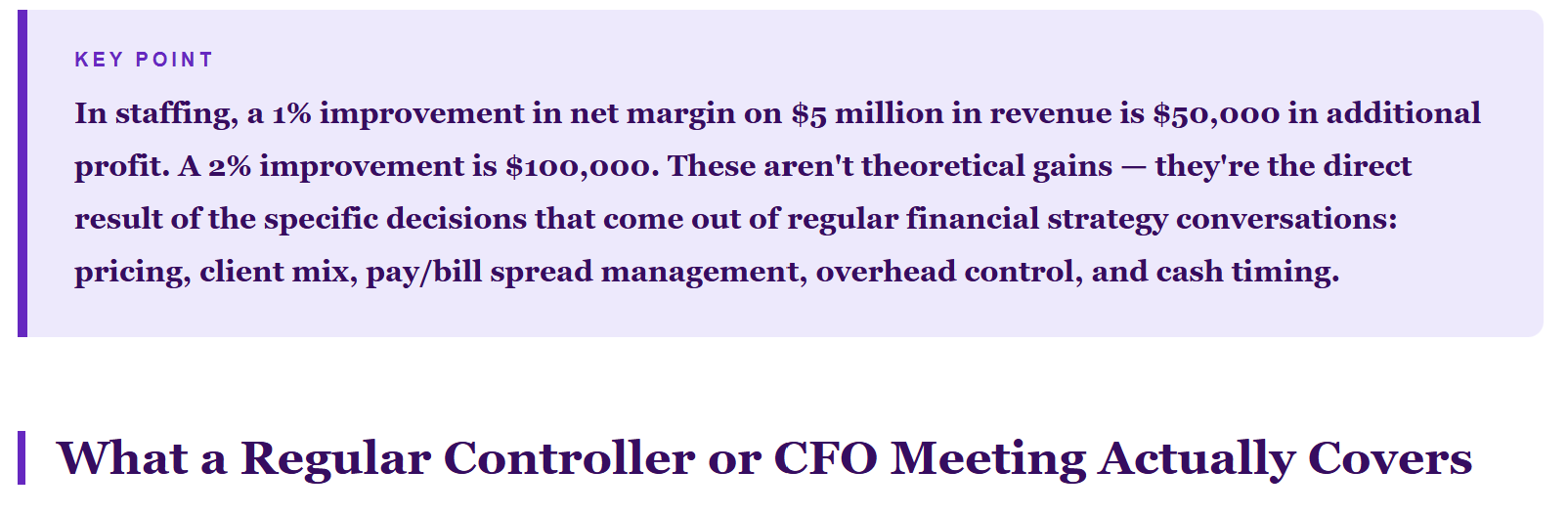
When staffing company owners hear "controller" or "CFO," they sometimes picture someone who manages the books. That's a bookkeeper. A controller or CFO does something fundamentally different: they interpret the numbers, model the implications of decisions, and help leadership see around corners.
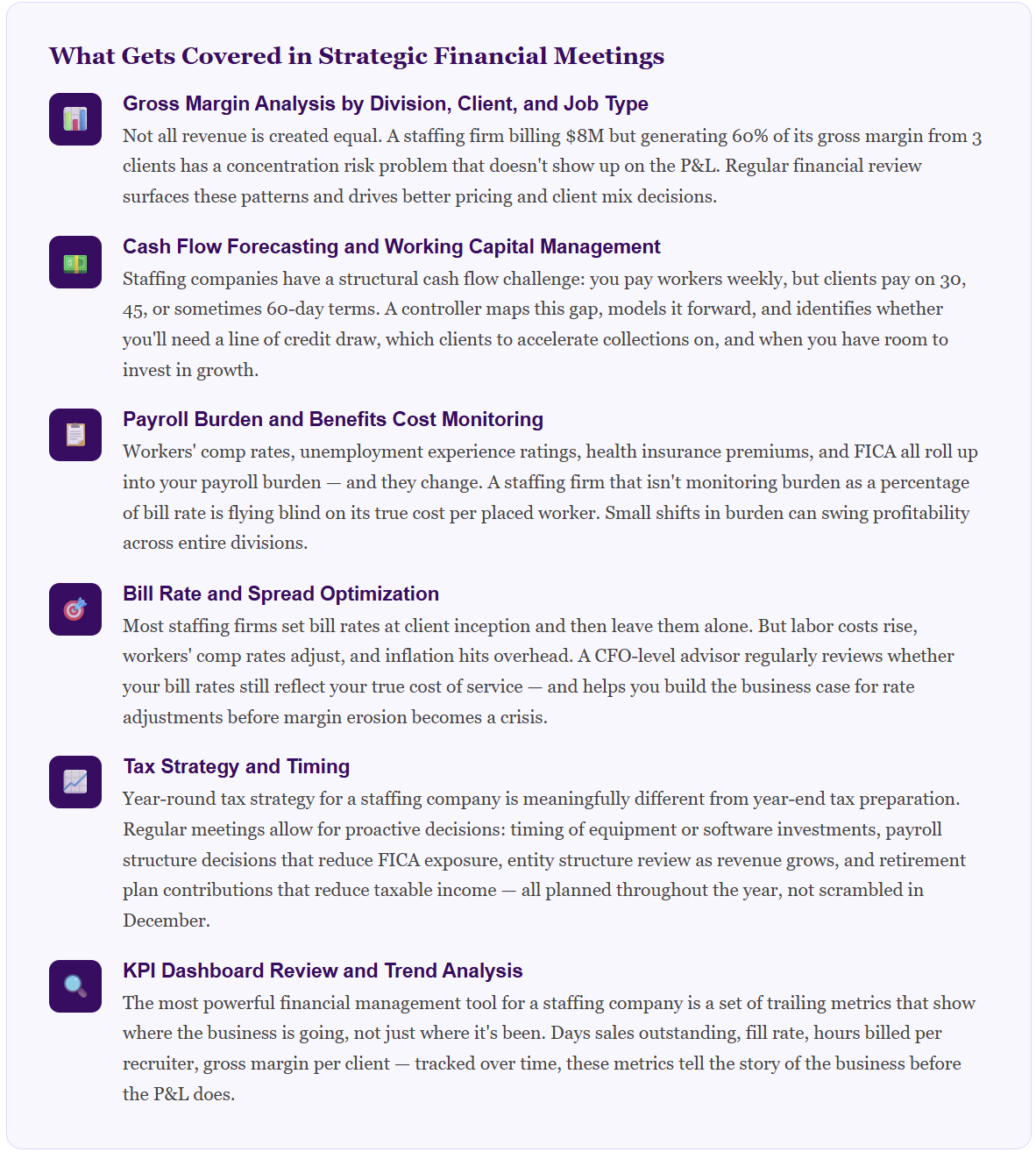
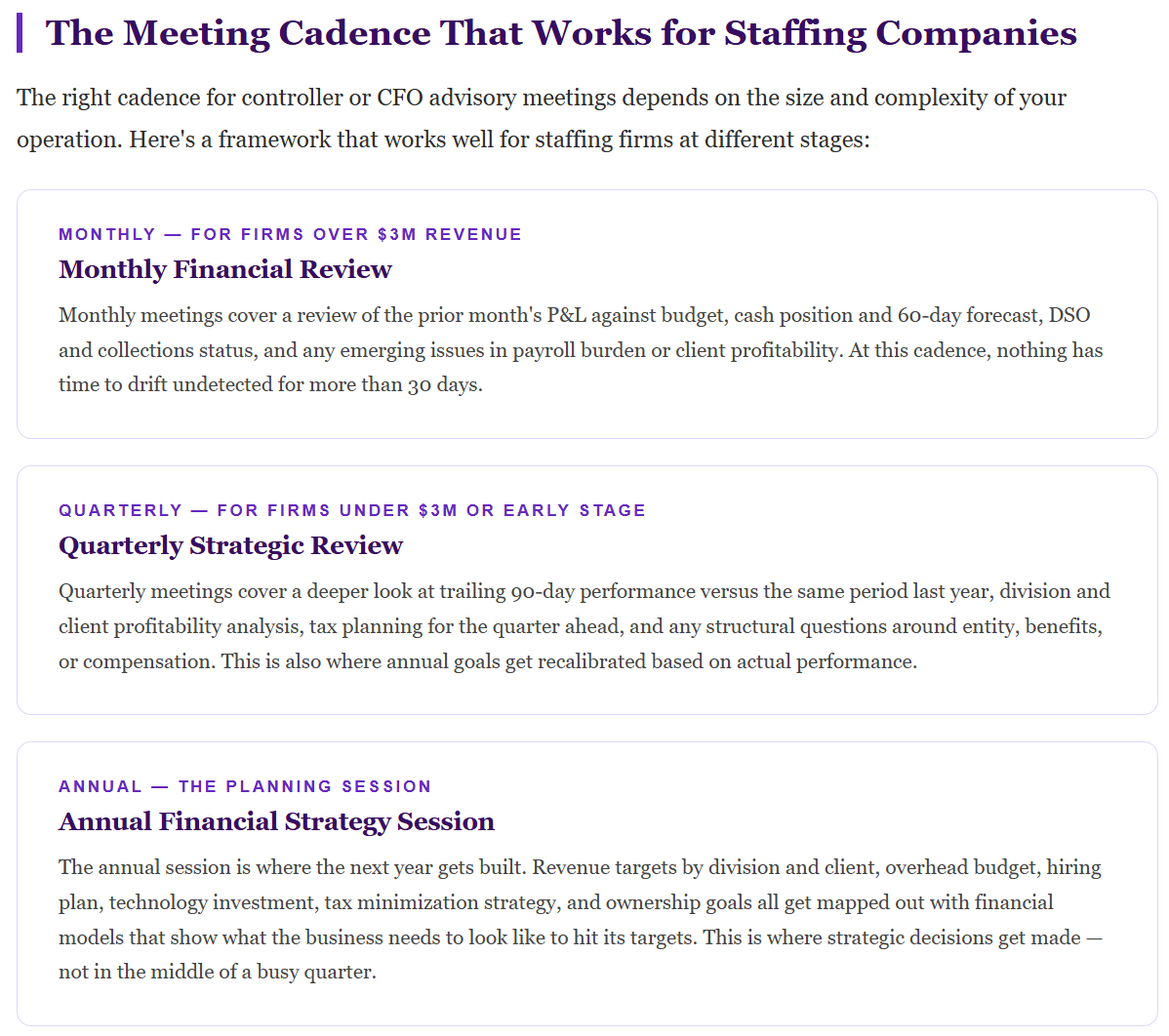
In a well-run advisory engagement for a staffing company, regular meetings cover the following areas — not once, but on a cadence that keeps the business dialed in all year:
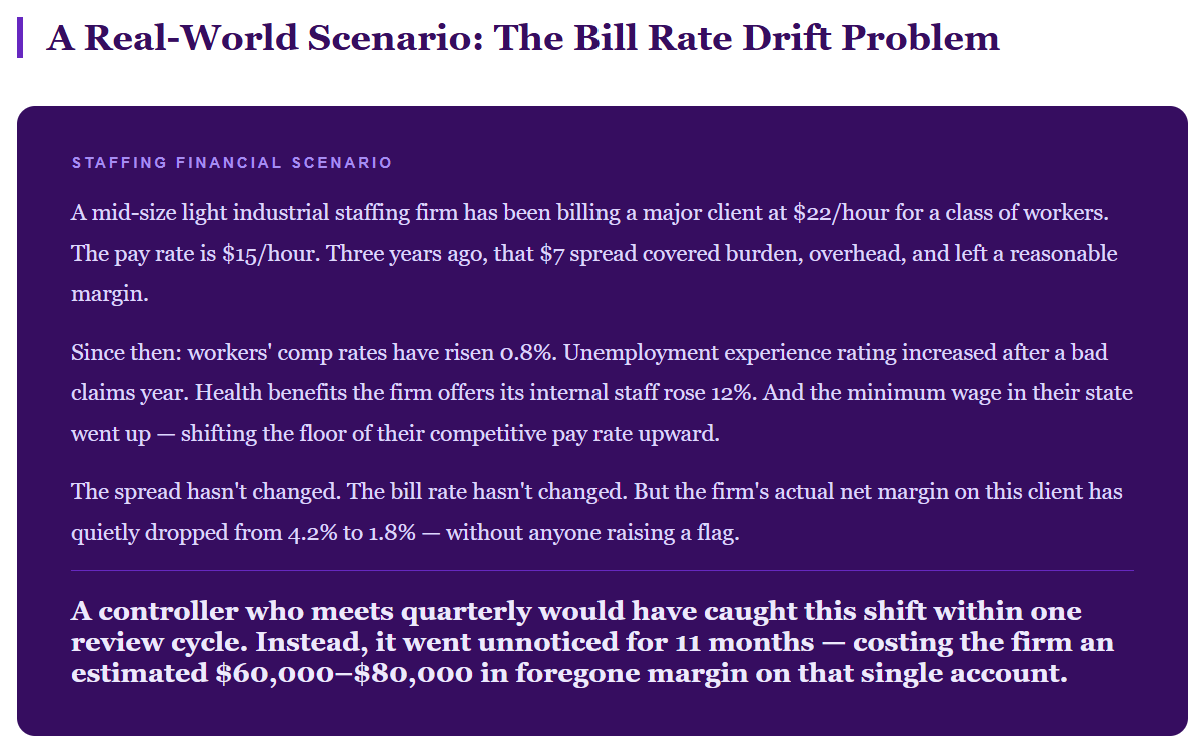
This is not a dramatic story. It's an ordinary one. And it happens in staffing firms of every size, in every market, every year — because the financial drift is gradual enough to be invisible without the right monitoring infrastructure.
Frequently Asked Questions
What's the difference between a bookkeeper, a controller, and a CFO — and which does my staffing firm need?
A bookkeeper records transactions. A controller manages the accuracy and integrity of financial reporting, monitors key metrics, and handles month-end close. A CFO provides strategic financial leadership — modeling decisions, managing capital, advising on growth and structure. Most staffing firms in the $1M–$10M range benefit most from controller-level engagement with periodic CFO-level strategic sessions. As revenue grows beyond $10M and complexity increases, a more active fractional CFO relationship becomes the right fit.
How is this different from just having a good accountant?
A traditional accountant — even a great one — is typically backward-looking. They tell you what happened. A controller or fractional CFO is forward-looking: they model what's going to happen, identify the decisions that change the outcome, and stay engaged between those decisions. For a staffing firm, where margins are thin and cash flow timing is structural, the forward-looking lens is where the real value lives.
My staffing firm is small. Is this overkill for my size?
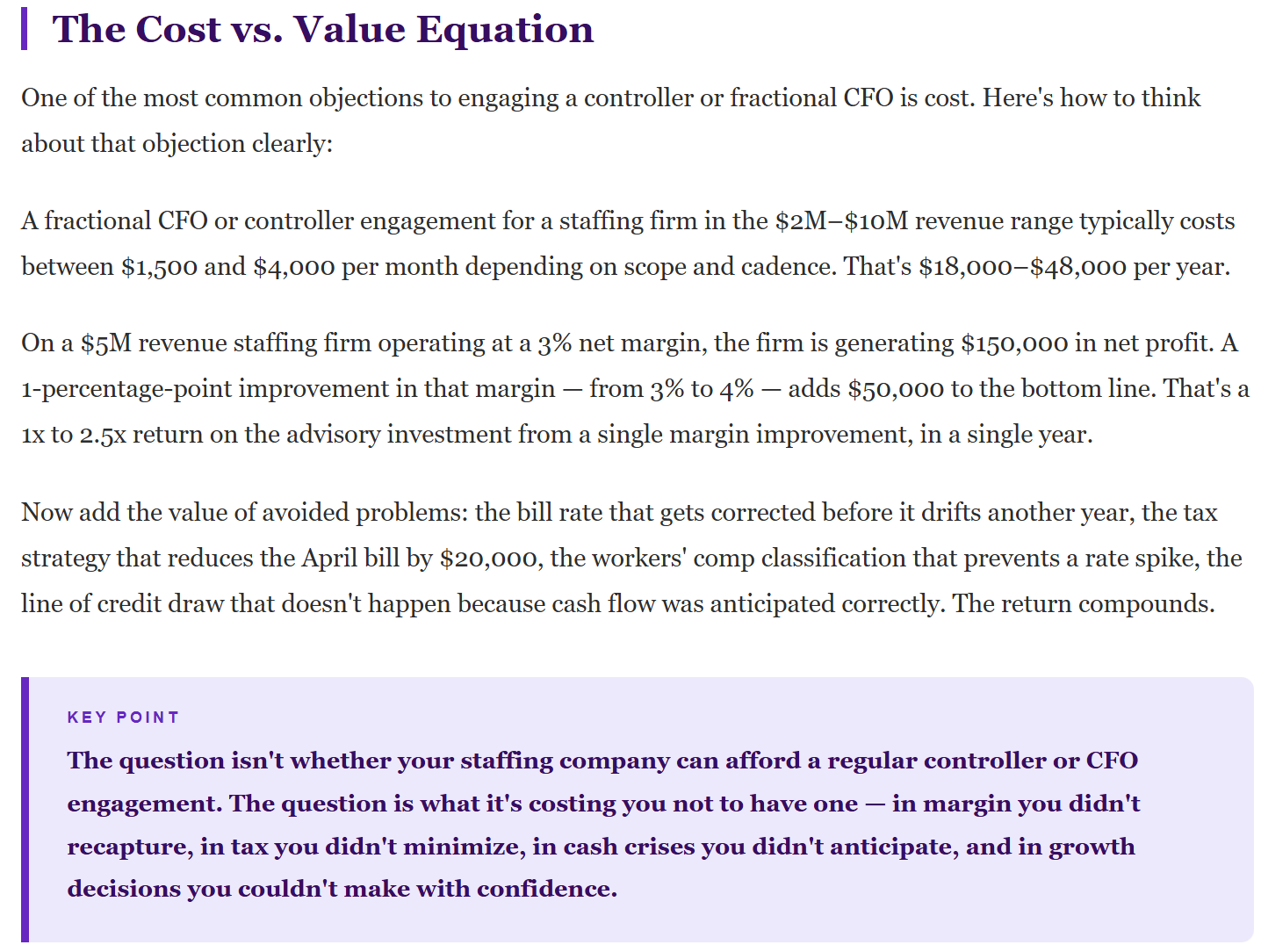
In most cases, no — and smaller firms often benefit more proportionally. A $2M staffing firm with a 1% margin is generating $20,000 in net profit. Even a modest improvement in pricing discipline or payroll burden management can double that. The advisory investment doesn't scale with revenue — the value it creates does. Smaller firms with less financial infrastructure to fall back on often have the most to gain from this kind of engagement.
What should I bring to a first financial strategy meeting?
At minimum: your trailing 12-month P&L, your balance sheet, your current accounts receivable aging, and a sense of your top clients by revenue and your gross margins by division if you track them. Don't worry about having everything organized perfectly — the first meeting is diagnostic, and identifying what you don't currently track is itself valuable information.
Does C2E do this kind of engagement for staffing companies?
Yes — this is one of our core service areas for staffing industry clients. We work with staffing companies on a regular advisory basis: reviewing financial performance, managing tax strategy year-round, analyzing client and division profitability, and helping ownership make informed decisions about growth, structure, and margin. If you're not sure whether your firm would benefit, a first conversation costs nothing and usually surfaces something immediately actionable.